
Proximity, Smart and Magnetic Stripe Cards: Encoding Explained
A clear guide to proximity, smart and magnetic stripe card encoding, what each technology does and how to choose the right one for your organisation.
An ID card only becomes a working credential once a machine can read it. That step is called encoding, and it is the difference between a printed badge and a card that opens a door, clocks a shift or verifies an identity. Understanding proximity, smart and magnetic stripe card encoding helps organisations in Zambia choose the right technology the first time, avoid costly re-issues and build systems that scale. This guide explains the main encoding methods, where each is used and how to bring printing and encoding together in one efficient process.
What card encoding means and why it matters
Encoding is the process of writing digital data onto a card so a reader can recognise it. A printed card shows a name, a photo and a logo to human eyes. An encoded card also carries hidden data, such as a unique number, a credential or an access key, that machines use to grant or deny access, record attendance or authenticate a transaction. In short, printing is what people see and encoding is what systems read.
That data can live on a magnetic stripe on the back, in a wireless chip and antenna embedded in the card body, or on a visible contact chip on the front. Each approach suits different needs, budgets and security levels, so choosing well at the start saves reprinting and re-encoding later.
Magnetic stripe cards: how they work and typical uses
The magnetic stripe is the black or brown band on the back of a card. Data is written to it by magnetising tiny particles in tracks, much like a cassette tape, and a reader detects those patterns as the card is swiped. Stripes come in two common types:
- LoCo (low coercivity), usually brown, cheaper and easier to write but more prone to accidental erasure
- HiCo (high coercivity), usually black, more durable and better suited to cards used daily
Inexpensive and simple, magnetic stripe cards stay popular for loyalty and membership cards, gift cards, hotel room keys and basic access. The trade off is security and durability, as stripes wear with swiping, can be copied with basic equipment and hold little data. For sensitive access control most organisations now prefer contactless technologies, but magnetic stripe remains a sensible, low cost choice where the risk is low and the volume is high.
Proximity (125 kHz) cards for access control
Proximity cards, often shortened to prox, use a low frequency radio signal at 125 kHz. The card contains a small chip and an antenna, and when it is held near a reader, the reader powers the chip wirelessly and reads its number. With no need to swipe or insert the card, prox is fast and hard wearing because there is no physical contact.
Proximity cards have been the workhorse of building access control for many years. Reliable and quick to present, they are widely used for door and gate access in offices, schools and clinics, car park barriers and attendance clocking. The limitation is that classic 125 kHz prox generally stores only a fixed number with little encryption, so it can be captured and cloned by a determined attacker. For many sites this is an acceptable risk, especially where prox is combined with a PIN or a guard, but where higher security is needed, contactless smart cards are the better path.
Contactless smart cards (13.56 MHz, MIFARE)
Contactless smart cards operate at a higher frequency of 13.56 MHz and include well known families such as MIFARE. Like prox cards they are read by tapping near a reader, but they are far more capable. Instead of a single fixed number, a smart card holds memory organised into protected sectors, and many support encryption and mutual authentication between card and reader.
That extra capability enables much more than opening a door:
- Secure access control with encrypted credentials that resist cloning
- Cashless payment on campus, in canteens or at vending machines
- Library, printing and locker management
- Multiple applications on one card, so a single staff or student card can do several jobs
Because the data is protected and the card holds more information, contactless smart cards are the preferred choice for schools, universities, hospitals, mines and government bodies that want a single secure credential across many systems.
A quick comparison
| Technology | Frequency | Contact | Typical use | Security |
|---|---|---|---|---|
| Magnetic stripe | n/a | Swipe | Loyalty, gift, basic access | Low |
| Proximity | 125 kHz | Tap | Doors, gates, attendance | Basic |
| Contactless smart | 13.56 MHz | Tap | Secure access, cashless, multi use | High |
| Contact smart chip | n/a | Insert | ID, banking, high assurance | Very high |
Contact smart chip cards
Contact smart cards carry a visible gold chip on the front. Rather than being read wirelessly, the card is inserted into a reader so the chip touches the reader's contacts, much like a chip and PIN bank card. This physical connection supports a secure processor that performs cryptographic operations and stores credentials to a high standard.
Contact chip cards are chosen where assurance matters most:
- National ID and government credentials
- Banking and payment cards
- Secure logon to computers and networks, often with a certificate on the chip
The chip can hold digital certificates and keys, enabling strong authentication and digital signatures. Insertion is slower than a tap, so contact chips are usually reserved for higher security or regulated uses rather than everyday doors. Many cards also combine a contact chip with a contactless interface.
Combining printing and encoding in one pass
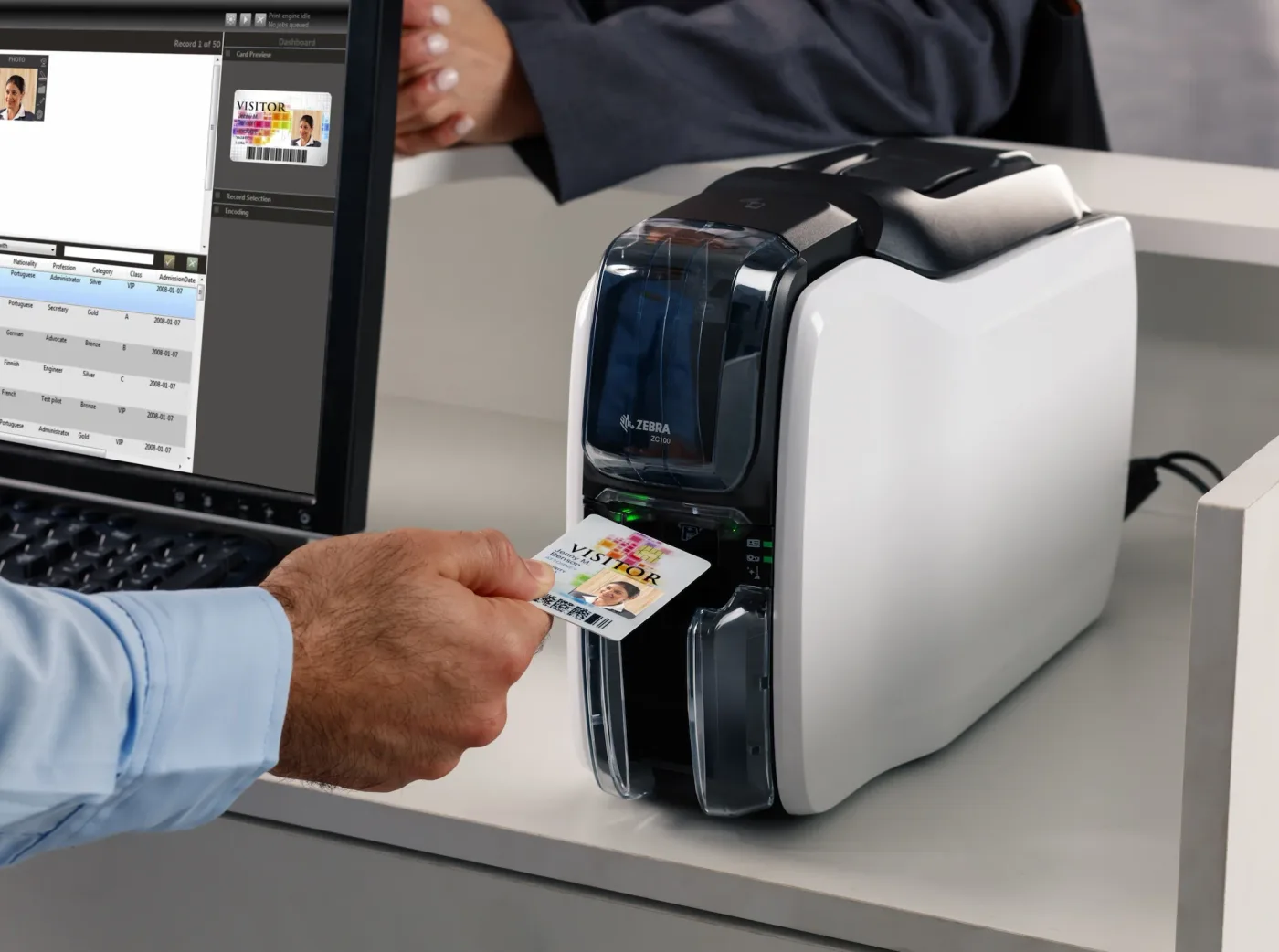
A major advantage of a modern card printer is that it can print and encode in a single operation. The card is drawn in, personalised with the photo and details, encoded with the relevant data and delivered ready to use. There is no separate encoding station and no manual step to match data to the right person, which reduces errors and speeds up issuance.
Printers can be fitted with one or more encoding modules to match the card technology: magnetic stripe for stripe cards, contactless for proximity and smart cards, and contact chip for chip cards. Printers from brands such as Entrust (Sigma and Artista), Zebra and Evolis can be specified with these modules so a single machine both prints and encodes. This inline approach matters most for volume issuance, such as a school enrolling hundreds of pupils or a mine badging a large workforce, with every card personalised and credentialed, ready to tap or swipe on day one.
Choosing the right technology for access control and time and attendance
The right choice depends on your security needs, your existing readers and your budget. A few practical principles help:
- Match the card to the readers you already have. If your doors run 125 kHz prox, new cards must use the same technology, or you must plan a reader upgrade alongside any smart card rollout.
- Weigh security against cost. Magnetic stripe is cheapest but weakest, proximity is convenient and affordable for everyday doors, contactless smart cards cost more but add encryption and multi application use, and contact chips suit the highest assurance cases.
- Think about the future. If you may add cashless payment, library or canteen systems later, a contactless smart card gives room to grow on one credential.
- Consider the environment. Mines and outdoor sites favour contactless because there is no stripe to wear and no slot to clog with dust.
For time and attendance specifically, a contactless card, whether prox or smart, is usually ideal. Staff tap on arrival and departure, the reader logs the time and the data flows into payroll. Contactless is fast at busy shift changes and stands up to daily use far better than a magnetic stripe. If you are unsure, start with what your readers already accept, then choose the highest security your budget allows.
Doneright supplies the printers, encoding, readers and access control
Getting proximity, smart and magnetic stripe card encoding right is easier with a partner who supplies the whole chain rather than just the plastic. Doneright Systems Limited, based in Lusaka, sells, installs, trains on and supports ID card printers, and issues genuine consumables from Lusaka stock. The brands we carry, including Entrust (Sigma and Artista), Zebra and Evolis, can be configured with magnetic stripe, contactless and contact chip encoding so your cards are printed and credentialed in one pass.
We also supply the readers and access control that sit behind the cards, so your credentials, doors and attendance systems work together from the start. Whether you are a business, school, NGO, bank, mine or government body, we help you pick the right technology, set it up correctly and keep it running with local support. To discuss the best encoding option for your organisation, request a quote or ask our team for advice.
Planning an ID card or security rollout?
Tell us what you are issuing, securing or tracking. A specialist responds within one business day.
- Genuine stock
- Zambia-wide delivery
- Local support
Secure ID Card Printing: The Security Features That Matter
The physical, printed and electronic security features that make ID cards hard to forge or clone, and how to lock down issuance in Zambia.
Why the HDP6600 is The Best 600 DPI Re-Transfer ID Card Printer
This article highlights the HDP6600 as the top re-transfer printer for efficient Zambia-based business operations with strong security and reliability features.

How to Choose the Right ID Card Printer for Your Organisation
A practical buyer's guide to choosing the right ID card printer for your Zambian organisation, from print volume and card technology to running costs.